
Metals And Mining Review


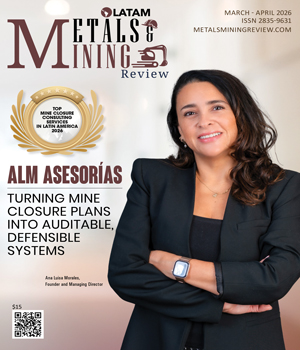
 Ana Luisa Morales, Founder and Managing Director
Closure is one of the most consequential phases in a mining operation’s lifecycle. In Chile, Law 20,551 sets a demanding standard for how closure plans are structured, costed and rationalized. Regulators evaluate consistency, evidence and defensibility. A plan can be technically sound and still fail, not because the engineering is wrong, but because the document cannot prove what the operator committed to do, how it will be verified, what it will cost and when it will happen. When those proof chains break, operators absorb the consequences. Observation cycles lengthen. Guarantees recalibrate upward. Closure loses its shape as a financial variable.
Many operators meet the standard on paper. Few build plans that survive audit without friction. ALM Asesorías closes that gap.
Founded in 2018 and headquartered in Santiago, ALM is a specialized consulting firm focused on mine closure planning, regulatory auditing and technical-economic alignment across Chile and Latin America. Ana Luisa Morales leads it as founder and managing director. She brings direct regulatory expertise in Law 20,551 and its implementing regulation, Supreme Decree No. 41, along with experience advising mining companies, government agencies and multilateral institutions across the region. That experience gives her a consistent vantage point across the plans' ALM reviews.
 Her finding is the same in nearly every case. General narratives sit where facility-level architecture should exist. Measures appear as declarations without verifiable criteria; no defined standard, no scope, no method for demonstrating compliance in practice. Cost estimates float as lump sums detached from quantities, assumptions or productivity rates. Schedules contradict operational timelines, with mothballed or planned facilities sitting without a clear closure regimen. Commitments under the Resolución de Calificación Ambiental (RCA), the Sistema de Evaluación de Impacto Ambiental (SEIA) and sectoral permits appear only partially, without traceability to specific closure measures. Physical and chemical stability risks are treated contextually rather than through control logic with thresholds, triggers and evidence chains.
“Operators do not set out to build weak plans,” says Morales. “They set out to close a regulatory requirement. That mindset produces a document. What it does not produce is a system their own teams can use to manage closure five, 10 or 30 years from now.”
Exposure rarely comes from what an operator cannot do. It comes from what a plan cannot prove.
Inverting the Sequence
How does starting from regulatory requirements change mine closure planning outcomes?
 Most engineering firms build closure plans as extensions of mine design. They engineer a solution and package it into a regulatory format. ALM inverts that sequence. It starts from Law 20,551, approved environmental commitments under the SEIA process, RCA resolutions and sectoral permits. Engineering, costing and scheduling serve that regulatory foundation instead of the other way around.
Each facility becomes a discrete control unit. Each regulatory commitment connects to a closure measure, a verifiable criterion, documentary evidence, a work breakdown structure (WBS) line item, a cost estimate, a schedule entry and a financial guarantee calculation. Every element aligns vertically, with no generic line items, duplications or orphan measures.
Operators do not set out to build weak plans. They set out to close a regulatory requirement. That mindset produces a document. What it does not produce is a system their own teams can use to manage closure five, 10 or 30 years from now.
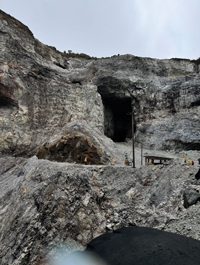 Risk assessment builds the control logic. ALM identifies hazards—extreme precipitation, debris flows, prolonged drought, wind, extreme temperatures—and maps them to failure mechanisms, such as erosion, saturation, cover degradation, sediment transport and the mobilization of salts or contaminants. Each hazard connects to a performance criterion, an operational threshold, a closure measure, a care-and-maintenance protocol and documentary evidence. Robustness over 20 or 50 years requires a well-defined sequence of control, verification and triggered response.
Planning converts findings into a corrected plan. Cost items are broken down to the facility-level scope, with explicit assumptions and productivity rates. Schedules align with approved mine life and operational status. When operators present lump-sum estimates without facility-level scope, regulators face uncertainty, which drives conservative recalibration. ALM’s restructuring removes that ambiguity. Guarantees recalibrate on traceable cost structures, strengthening both guarantee and liability governance under Law 20,551.
“When an operator can defend every cost line to its facility, measure and schedule, the conversation with the regulator changes,” says Morales. “You are no longer explaining what you meant. You are showing what you built.”
Gaps in access, logistics, treatment, care and maintenance, monitoring, surveillance and post-closure costs are identified and closed. Double counting is eliminated.
-
Writing a closure guide for five countries forces you to see where regulatory logic holds and where it breaks across jurisdictions. That perspective informs every plan we build. We are applying what we have learned about how closure frameworks perform under pressure.
Submission support is the final quality gate. Document consistency is ensured across the full package and technical responses are prepared for anticipated observations. Its review process mirrors how the authority evaluates, testing each facility for weaknesses that trigger formal comments. ALM does not design plans to survive observations after submission. It designs them so that those observations never arise.
Shaping Regional Standards
How does regional regulatory experience influence mine closure planning frameworks and methodologies?
ALM’s structural logic extends into the institutional frameworks that shape mine closure practice across Latin America. Morales contributed to a Methodological Guide for Mine Closure covering Bolivia, Colombia, Ecuador, Peru and Chile, published by the Economic Commission for Latin America and the Caribbean (CEPAL) in 2020. The broader body of regional work on mine closure, including subsequent analyses of Law 20,551 and technical guidance on risks, audits, financial guarantees and chemical stability supervision, reflects the evolving regulatory frameworks she works within and helps shape in practice.
“Writing a closure guide for five countries forces you to see where regulatory logic holds and where it breaks across jurisdictions,” says Morales. “That perspective comes back into every plan we build. We are applying what we have learned about how closure frameworks perform under pressure.”
What value does proactive gap identification provide before regulatory review of closure plans?
Client engagements confirm the pattern. Operators cite two of ALM’s most valued qualities. It resolves structural gaps before plans enter formal review and it diagnoses with technical honesty what regulators will challenge. In one engagement, ALM identified unincorporated RCA commitments and schedules that were misaligned with the approved mine life. Cost items were presented as lump sums without a facility-level breakdown. ALM restructured the plan with a traceable scope and updated climate assumptions. It recalibrated guarantees and built the cost-to-schedule-to-commitment alignment that the authority expects. The operator gained internal control over long-term obligations and avoided the observation cycle that typically follows incomplete submissions.
That record earns ALM Asesorías recognition by Metals and Mining Review as a Top Mine Closure Consulting Services provider in Latin America for 2026. It is a distinction built on regulatory precision and rigor applied consistently across every engagement.
Selecting Mine Closure Consulting Services in Chile's Regulatory Framework
Mine closure in Chile is no longer a downstream compliance task. Law 20.551 and its implementing regulation have elevated closure planning into a technically demanding, economically scrutinized and regulator-facing discipline that extends across the life of a mining asset. Executives responsible for acquiring mine closure consulting services must treat the Closure Plan not as a static filing but as a structured commitment that links engineering measures, environmental risk, cost estimates and financial guarantees under the review of SERNAGEOMIN and environmental authorities.
Regulatory expectations now hinge on traceability and internal coherence. Authorities examine whether each facility is clearly defined, whether closure measures are supported by verifiable criteria and whether cost items can be broken down and reconciled to guarantees. Gaps frequently emerge where RCA or SEIA commitments are not fully incorporated into the Closure Plan, where schedules diverge from approved mine life, or where assumptions lack documentary support. Each inconsistency extends review cycles, increases regulatory exposure and complicates financial provisioning.
A disciplined advisory approach begins with a comprehensive diagnostic. This includes reviewing the Closure Plan, sectoral permits, facility inventories, supporting studies on physical and chemical stability, prior audits and outstanding commitments. It also requires assessing environmental and regulatory risks alongside technical feasibility. When this diagnostic is structured into a prioritized action path, management gains clarity on which measures require redefinition, which studies must be updated and where cost traceability must be reinforced.
Executives should expect planning that moves beyond narrative descriptions. Closure measures require defined scope, item-level breakdown, traceable units and schedules aligned with approved mine life. Financial guarantees must reflect updated, defensible cost estimates. Consistency across technical documentation, cost models and regulatory submissions becomes essential, particularly as scrutiny of evidence increases and long-term risk variables, including climate-related stressors, are incorporated into closure logic.
Technical audits and planning must function as an integrated cycle rather than separate workstreams. An audit that identifies gaps without converting them into structured corrections leaves exposure unresolved. Effective mine closure consulting services transform findings into a traceable framework that links facility, measure, verifiable criteria, supporting evidence, cost and timeline. This structure improves responses to formal reviews and inspections while strengthening internal control over closure liabilities.
In this environment, ALM Asesorías stands out for grounding its advisory model in regulatory interpretation translated directly into engineering, costing and documentation practices. It begins with a staged diagnostic covering Closure Plans, RCAs, permits, facility inventories, cost structures and guarantees, followed by risk-based prioritization across physical, chemical, environmental and regulatory dimensions. It converts audit findings into a structured, facility-level framework that links measures to evidence, costs and schedules, ensuring full consistency with Law 20.551, Supreme Decree No. 41 and environmental commitments.
Its methodology emphasizes facility-level traceability, WBS alignment and auditable linkages between commitments, measures and financial guarantees, supported by compliance matrices, checklists and structured submission preparation. Founded in 2018 and headquartered in Chile, it provides mine closure advisory across Chile and Latin America, with focus on internal audits, plan updates, technical–economic traceability and regulatory support.
For executives seeking to reduce regulatory uncertainty while strengthening the defensibility of Closure Plans, ALM Asesorías represents a disciplined and well-aligned choice
...Read more
Company
ALM Asesorías
Management
Ana Luisa Morales, Founder and Managing Director
Description
ALM Asesorías is a specialist mine closure consulting firm that audits and updates closure plans for mining operations across Chile and Latin America. The firm translates regulatory requirements into defensible engineering, cost and planning decisions that withstand sustained regulatory review.